

Best Websites for Moving Companies: 10 Examples & The Complete Build Blueprint
A great move starts long before the truck arrives—it starts the moment your website loads.
Residential and commercial moving is a high-intent, time-sensitive service. In the U.S., annual industry revenues are measured in the tens of billions, driven by local apartment churn, corporate relocations, and interstate moves. Average consumer spend varies widely: local moves often cluster between $800–$2,000 depending on crew size and hours; long-distance and full-service packing can exceed $4,000–$10,000 per job. Booking demand spikes on weekends, end-of-month, and late spring through summer, when speed to schedule and price clarity win most clicks—and most revenue.
Project the upside: a regional mover that captures just 120 local moves per month at a conservative $1,350 average invoice can exceed $1.9M in annual revenue; add 15 long-distance moves per month at $5,500 average and the total quickly pushes past $2.9M. Operators that present instant quotes, real calendars, and credible reviews convert at materially higher rates, protecting margins even when ad costs rise.
Your site is no longer a brochure; it’s your dispatcher, estimator, and sales rep in one. The winners combine an ultra-fast booking path with transparent pricing ranges, inventory and access questions (stairs, elevator, parking), true service-area signals, and trust elements that calm the two biggest anxieties: cost surprises and crew reliability.
Top 10 Real-World Moving Websites
1) PS Moving & Logistics
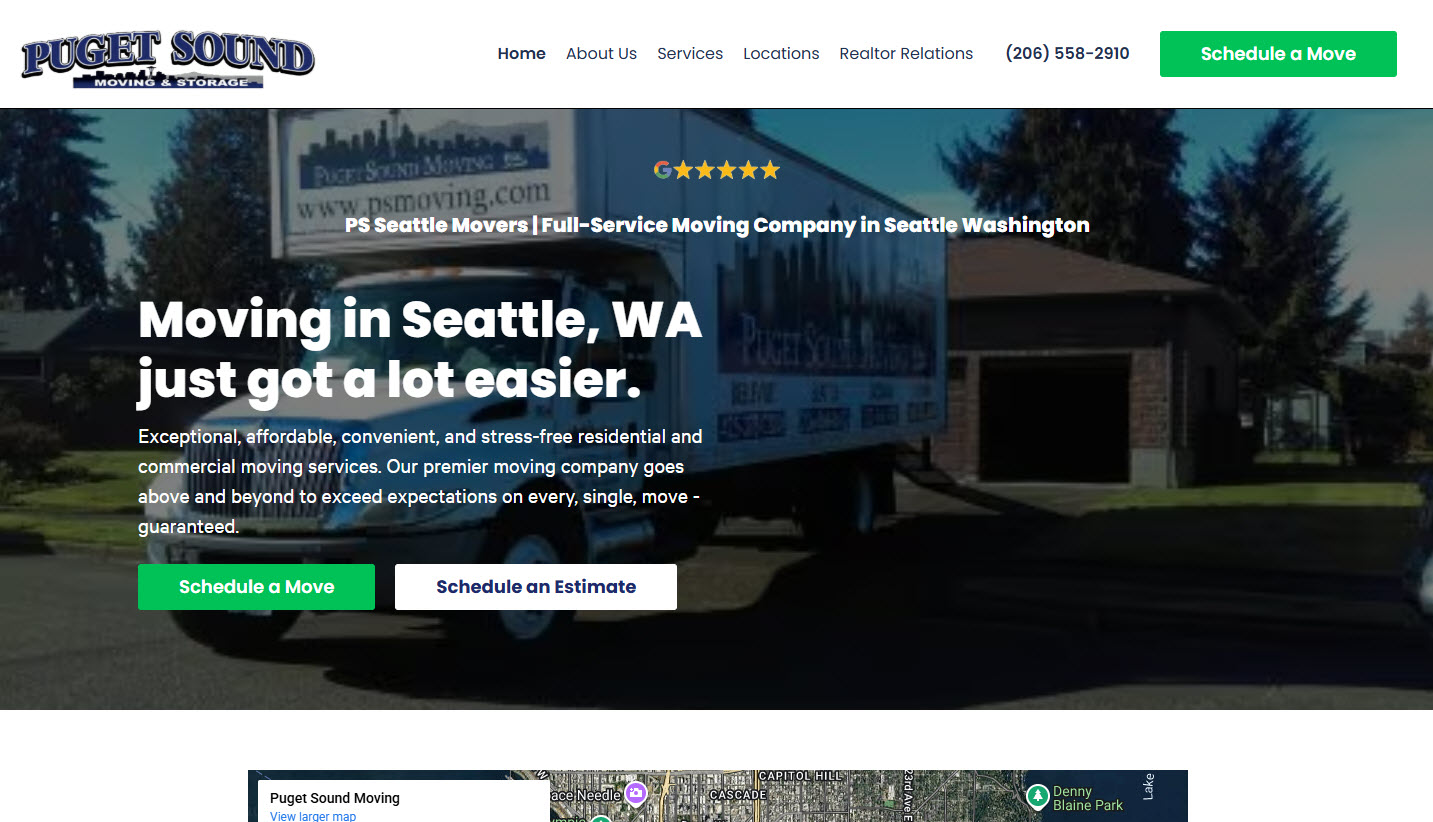
Puget Sound Movers leads with clarity. The hero offers direct paths—“Get a Quote,” “Book Your Move,” and “Call”—while the copy sets expectations for crew size, packing help, and timelines. City pages emphasize neighborhoods served and common building types, which helps visitors feel understood. The Google Business Profile quote flow keeps fields minimal yet meaningful (inventory, stairs/elevator, distance), reducing drop-off and producing accurate ETAs.
2) Mayflower (National Benchmark)
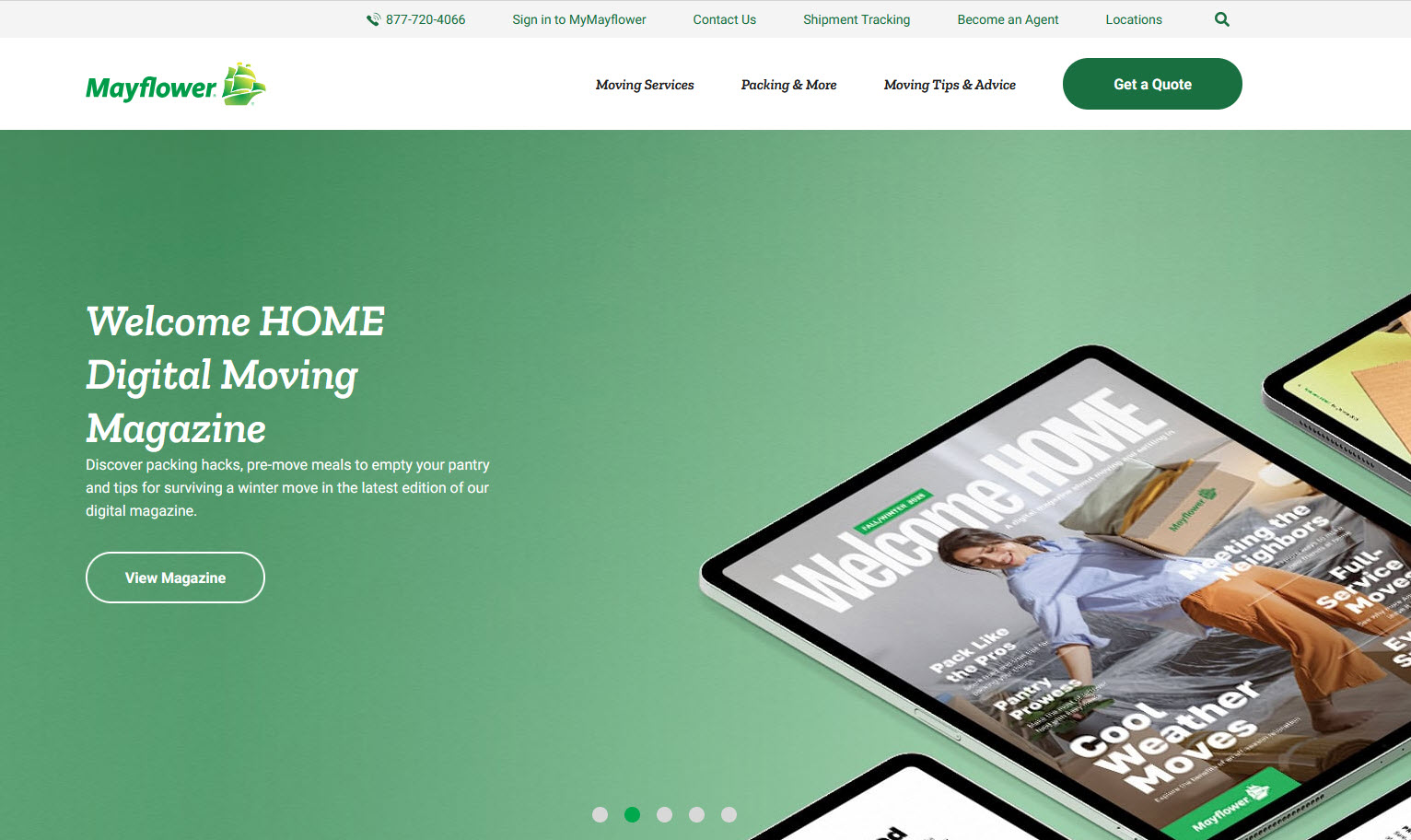
Mayflower Moving website has a clear, confidence-first experience that pairs interstate authority with a straightforward quote process. Content depth—packing tips, checklists, and timeline guides—supports research-mode visitors without burying the “Get a Quote” button.
2) TWO MEN AND A TRUCK
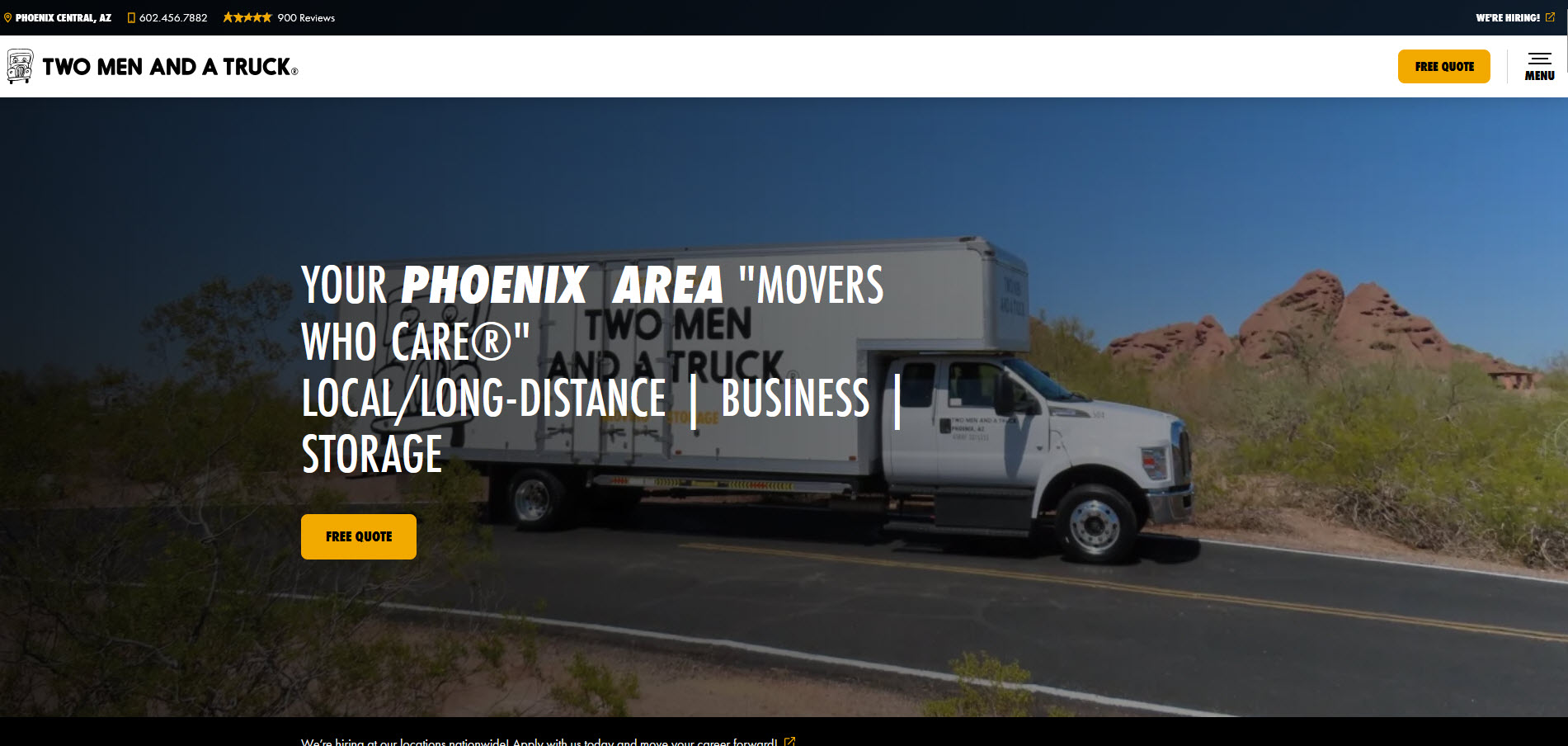
TWO MEN AND A TRUCK is a masterclass in franchise-scale UX. Visitors can choose service types (local, long-distance, packing, storage) and immediately see location-specific options. The site balances brand consistency with localized proof—nearby reviews, photos, and hours—while the sticky mobile CTAs make calling or scheduling a breeze from any screen depth.
4) Allied Van Lines
Strong conversion scaffolding with transparent service definitions (full-service, fragile-only, storage) and reassuring copy about claims handling and tracking. The design makes long-distance logistics feel manageable.
5) NorthStar Moving
Lifestyle-forward visuals and case-style stories show care and professionalism. Service pages address access issues (tight streets, high-rise moves), which reduces surprises on move day.
6) Gentle Giant
Reputation-rich pages that humanize the crew: bios, training standards, and post-move follow-up. The brand tone is calm and competent, which is exactly what anxious movers need to feel.
7) Bellhop
Simple, modern UI with an emphasis on speed. Date selection and crew availability appear early, so visitors know immediately if the preferred time is feasible.
8) FlatRate Moving
Clear value prop around flat-price transparency. The estimator communicates what’s included, limiting change-order contention and improving satisfaction.
9) International Van Lines
Great for complex, cross-border moves. The flow elicits the right information (customs, storage, special items) without overwhelming users, then moves them into a human-assisted quote.
10) College HUNKS Hauling Junk & Moving
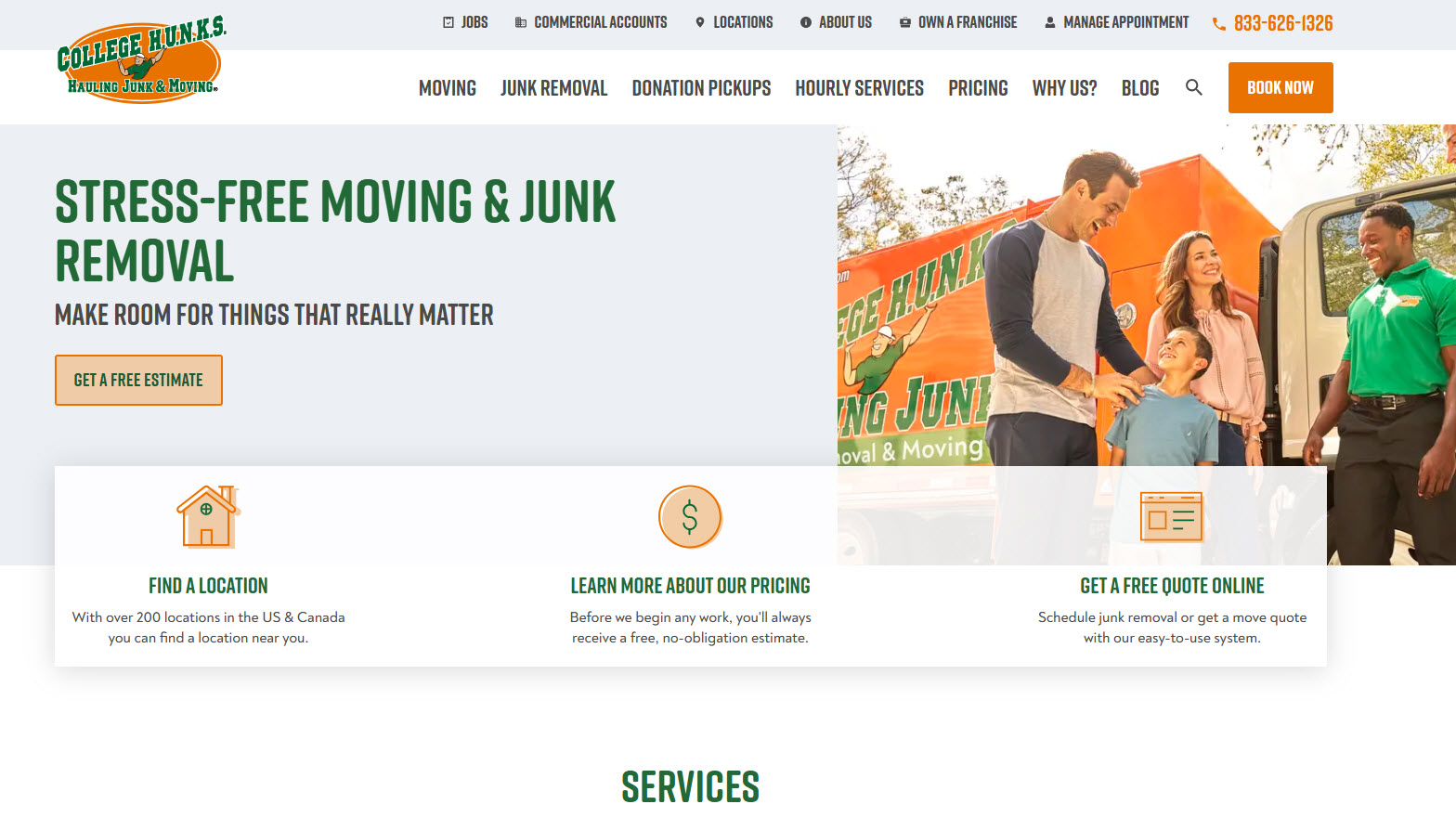
Smart dual-service architecture (moving + junk) that routes visitors efficiently. City pages are well localized with recent reviews, photos, and community involvement.
The Unified Strategy: The 60-Second Move-Booking Funnel
(One comprehensive strategy with focused sections. Each section begins with a short intro and then concrete actions.)
1) Positioning & One-Line Promise
Intro: Movers are chosen under time pressure. Your first line must promise ease, reliability, and price clarity in seconds.
Do this: Place a single, giant promise above the fold: “Fast, reliable movers with upfront pricing—book your crew in under 60 seconds.” Directly underneath, list three proof pillars: licensed & insured, hundreds of recent 5-star reviews, and on-time guarantee. Add service badges (local, long-distance, packing, storage) as chips for scannability.
2) Required Site Sections to Earn Trust (and Appear in AI & Search)
Intro: Depth and structure make both humans and ranking systems confident in recommending you.
Do this:
- Services Hub: Local, long-distance, apartment/high-rise, office moves, packing/unpacking, labor-only, storage, specialty (pianos, safes, antiques).
- Pricing & What’s Included: Honest ranges by job type, how pricing works (hourly vs. flat), travel fees, minimums, and overtime; sample invoices.
- Coverage Map + City Pages: Unique pages per city/ZIP cluster with building types, parking rules, HOA/elevator notes, and seasonal demand tips.
- Crew & Safety: Background checks, training standards, how items are protected (pads, wraps, floor runners), COI for buildings.
- Reviews/Case Stories: Recent, specific reviews with job context (studio walk-up vs. 3-bedroom suburban).
- Preparation & Checklists: Elevator reservations, parking permits, box labeling, “day-of” sequence.
- Claims & Insurance: How claims work, response times, and what’s covered.
3) Information Architecture that Reduces Cognitive Load
Intro: Most visitors arrive with a date in mind. Put availability and price expectations early.
Do this:
- Primary nav: Services, Pricing, Areas, Reviews, Resources, Book.
- Sticky mobile footer: Call, Book, Text.
- Hero: Date picker + city + move size (studio/1-bed/2-bed/office). Show the next available window instantly.
- Short quote form: Address auto-complete, stairs/elevator, special items, parking notes, packing help. Save progress so visitors can return easily.
A regional operations manager told us during a recent conversation, “If they can’t see a real date and crew window in under a minute, the lead starts shopping the next company.”
4) LLM & GEO Optimization (Generative Engine Optimization)
Intro: AI systems surface sources that are exact, structured, and hyper-local.
Do this:
- Topic clusters: Pillars for Local Moves, Long-Distance, Pricing, Packing, Building Access, and City Guides. Support each with Q&As like “How do hourly minimums work?”, “Elevator reservations for downtown high-rises,” and “Parking permits for historic neighborhoods.”
- Structured summaries: Start pages with a 2–3 sentence, straight-to-the-point answer, then deepen with details, images, and steps.
- Entity clarity: Keep company name, services, and areas consistent across pages; use unambiguous headings like “Moving Company in [City, State].”
- Local context: Mention neighborhoods, common building types, and seasonal patterns (end-of-month surges, dorm move-outs).
A content lead we spoke with summed it up: “LLMs prefer sites that read like a dispatcher and a foreman wrote them together—precise, procedural, and local.”
5) Traditional SEO Foundations (That Compound)
Intro: Basics still move mountains when they’re rigorous and consistent.
Do this:
- Intent-matched titles/H1s and descriptive slugs (e.g., /moving/[city]/apartment-movers).
- Internal links among clusters (pricing → services → city pages).
- Image alt text describing scene + service + city (“Crew wrapping sofa—local move—Phoenix”).
- Schema: LocalBusiness, Service (moving, packing), Product (flat-rate packages), FAQ, and Breadcrumbs.
- Performance: LCP < 2.5s, CLS < 0.1, INP < 200ms with compressed media and minimal JS.
6) Conversion Optimization & the ROI Math
Intro: Small UX changes compound into large revenue.
Do this:
- Baseline scenario: 8,000 monthly visits → 2.8% site-to-lead → 55% schedule rate → 45% close rate on scheduled jobs → avg invoice $1,250.
- Leads: 224 → Scheduled: 123 → Jobs: ~55 → Revenue ≈ $68,750/month.
- Tweak #1 (Availability calendar in hero): site-to-lead +0.8pp (to 3.6%).
- Tweak #2 (Shorter form + address auto-complete): schedule rate +7pp (to 62%).
- Tweak #3 (Pricing clarity + sample invoice): close rate +5pp (to 50%).
- New math: Leads 288 → Scheduled 178 → Jobs ~89 → Revenue ≈ $111,250/month.
That’s +$42,500/month or +$510k/year with three small changes. Another veteran sales director told us, “Calendar visibility on mobile is the single biggest lift we’ve seen—people book the slot they can see.”
- New math: Leads 288 → Scheduled 178 → Jobs ~89 → Revenue ≈ $111,250/month.
7) Visual Proof That Lowers Risk
Intro: Moves feel risky; pictures make safety visible.
Do this: Publish real crews, branded trucks, floor protection, wrapped furniture, stair carries, and elevator padding. Use short, captioned clips (“Protecting door frames,” “Wrapping TVs,” “Securing drawers”) and before/after of packed rooms. Authenticity beats stock every time.
8) Access & Logistics: Say the Quiet Part Out Loud
Intro: Buildings, parking, and elevators derail moves more than anything.
Do this: Add checklists by building type (walk-up, garden, high-rise, HOA gated). Explain COI, loading zones, truck lengths, and time windows. Provide templates for elevator reservations and permit requests, downloadable from city pages.
9) Pricing Transparency Without Sticker Shock
Intro: Honesty converts—ranges plus what pushes costs up or down.
Do this: “Most local studio moves: $X–$Y with a 2-mover crew; 2-bedroom: $A–$B.” List cost drivers (stairs, long carries, packing add-ons) and cost reducers (elevator reserved, truck parking secured). Show what’s included (pads, shrink wrap, wardrobe boxes).
10) Reputation Engine & Social Proof
Intro: Recent, specific reviews beat generic star counts.
Do this: Surface the latest 8–12 reviews per city with job context and photos. Add a “Your Crew” card on the confirmation page with names, photos, and ETA tracking to personalize the experience and reduce no-shows.
11) Post-Booking Comms That Prevent Problems
Intro: Great moves are choreographed in advance.
Do this: Automatic SMS/email with prep steps, elevator/permit reminders, packing tips, and a reschedule link. Day-before “What to Expect” checklist reduces day-of surprises and improves crew efficiency.
The 60-Second Funnel: Implementation Checklist
- One-line promise + three proof pillars above the fold
- Hero date picker + city + move size; instant availability
- Short quote form (address auto-complete; stairs/elevator; special items)
- Transparent pricing ranges + sample invoice
- City/ZIP pages with building-type guidance and checklists
- Reviews with context; “Your Crew” card after booking
- Schema for LocalBusiness, Service, Product, FAQ, Breadcrumbs
- Core Web Vitals green; sticky mobile CTAs (Call/Book/Text)
- Topic clusters for AI: Pricing, Access, City Guides, Service Types, Packing
- Post-booking SMS/email cadence with prep reminders
Final Load-Out: Turn Searches into Scheduled Moves
Why the Shortest Path Wins
People book movers under pressure—lease deadlines, job starts, family logistics. The sites that win remove friction at every step: clear dates, honest price ranges, authentic crew proof, and immediate scheduling. That mix earns trust from both visitors and modern AI systems, which increasingly recommend sources that feel authoritative, exact, and local.
Your Blueprint Is Ready
Use the ten examples as a pattern library and the 60-Second Move-Booking Funnel as your build sheet. When your site can answer “Can you move me on this date, at this price range, with a crew I can trust—and can I book now?” you’ll rise in AI placements, rank higher in traditional search, and turn more first-time visitors into confirmed jobs.
Need more inspiration, check out more moving websites.
OUR PROCESS
We Build Your Enterprise Software & Mobile Apps


team
Our leadership team